
US, Canada, Australia - Tighter rules on air freight shipments – Impact on FIDI Affiliates
Updates regarding the US rules
The Transportation Security Administration (TSA) requirement for Established Business Relationship (EBR) documentation on certain international cargo shipments has expired. As a result, the Freight Forwarder Declaration form is no longer required when tendering cargo to or through the United States from designated countries
Airlines are becoming stricter with the description details for AWBs:
o Any description that is considered vague or unacceptable will result in the rejection of the shipment; descriptions- such as UNACCOMPANIED AIR BAGGAGE / DIPLOMATIC SHIPMENT (clothes, monitors, pillows, toys, kitchenware), etc., will be held by customs.
o Instead, a compliant description example is “COTTON KNITTED SWEATERS AND SOCKS, DOWN COMFORTER, COTTON T-SHIRTS, WOOL PANTS, STAINLESS STEEL POTS AND PANS”.
What happened?
In response to increased civil aviation threats, the USA (United States Transportation Security Administration -TSA) and Canada (Transport Canada) have implemented new emergency measures, effective in respect of all shipments inbound to the US/Canada (destined for or transiting/transferring through), where such cargo originates from Europe and the Commonwealth of Independent States (CIS).
Shipments are now subject to more stringent screening processes, with particular focus on verifying consignor identities and ensuring cargo descriptions are detailed and accurate.
Australia followed with similar rules.
- Situation in the USA
- What and why?
- US Transportation Security Administration (TSA) emergency air cargo security measures including updates to the Air Cargo Advance Screening (ACAS) program
- Aimed at strengthening the security of cargo entering or transiting through the United States/Canada.
- New rules requiring airlines to report additional shipment information to the U.S. Transportation Safety Administration (TSA) at the time a shipment is tendered: more stringent pre-loading advance cargo information (PLACI) requirements.
- Who is impacted?
- Supply chain players, including air carriers, freight forwarders and moving companies
- Supply chain players, including air carriers, freight forwarders and moving companies
- Which shipments?
- Shipments arriving or transiting in the US from one of the listed countries where such cargo originates from Europe and the Commonwealth of Independent States (CIS) – see below table.
AD – Andorra KZ - Kazakhstan AL – Albania LI – Liechtenstein AM – Armenia LT -Lithuania AT- Austria LU – Luxembourg AZ - Azerbaijan LV – Latvia BA – Bosnia and Herzegovina MC – Monaco BE - Belgium MD - Moldova BG – Bulgaria ME - Montenegro BY - Belarus MK – Macedonia CH – Switzerland MT – Malta CY – Cyprus NO – Norway CZ – Czech Republic NL – Netherlands DE – Germany PL – Poland DK – Denmark PT – Portugal EE – Estonia RO – Romania ES – Spain RS – Serbia FI – Finland RU – Russian Federation FR – France SE – Sweden GB – United Kingdom SI – Slovenia GE – Georgia SK – Slovakia GR – Greece SM – San Marino HU – Hungary TJ - Tajikistan HR – Croatia TM - Turkmenistan IE – Ireland TR – Turkey IS – Iceland UA – Ukraine IT – Italy UZ – Uzbekistan KG - Kyrgyzstan VA - Vatican XK -Kosovo
- What and why?
- What are the regulatory changes?
- A complete declaration form must be submitted along with cargo documents at the time the shipment is turned over. The declaration must be submitted with every shipment.
- New data elements - more detailed information on the shipper and consignee (this includes elements such as shipper/consignee contact details). See latest version of the ACAS Implementation Guide (v2.3.3, 15 October 2024) and the Enhanced Air Cargo Advance Screening FAQs
- Established Business Relationship” or ‘Known Consignor Requirement’: Cargo can only be shipped if it originates from "known consignors" or if the shipper has an “established business relationship” with regulated freight forwarders or air carriers.
- Description of the shipment on the AWB : rejection of vague descriptions for air cargo – commodity description ‘Used Household Goods and Personal Effects’ is no longer acceptable since 12 November 2024.
- It is required to list the shipment contents as per the packing list. Any description that is considered vague or unacceptable will result in the rejection of the shipment.
- See list of acceptable descriptions acceptable descriptions
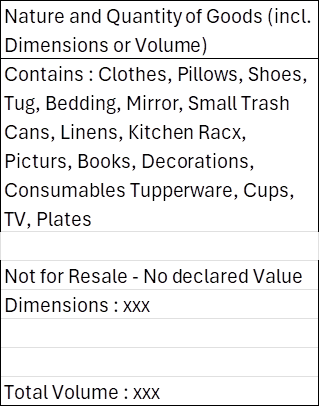
- Sample detailed description list on the AWB, shared by FIDI USA, considered acceptable - aim is to give a general idea of what is in the shipment (clothes, Kitchen ware, consumables, etc) - see table below:
- It is required to list the shipment contents as per the packing list. Any description that is considered vague or unacceptable will result in the rejection of the shipment.
- A complete declaration form must be submitted along with cargo documents at the time the shipment is turned over. The declaration must be submitted with every shipment.
What about Canada and Australia ?
Best is to contact the carrier for relevant instructions. In any case, it is recommended to FIDI Affiliates to reach out to their freight forwarders to have them defined in an ‘established business relationship’ as well as ensure to always have a proper packing list/inventory (as a back up for the AWB commodity description).
FIDI Canada’s feedback – status 25 Nov. 2024: These requirements are not yet widely enforced but it is likely Canada will follow the USA on this matter.
Who to contact ?
Do not hesitate to contact representatives from FIDI USA Board, FIDI Australia Board or FIDI Canada Board for further guidance depending on the destination of your shipments. Marie-Pascale Frix, FIDI Business Intelligence manager at marie-pascale.frix@fidi.org.